

Politics
Thousands of Bot Comments Buried a Town’s Budget Vote


STONEBRIDGE, Ont. — November 26, 2026 — The survey closed at midnight on Tuesday. By Wednesday morning, Stonebridge’s budget consultation had 4,318 responses — in a town where the last one drew 412.
Stonebridge is a fictional town of about 18,000 people in eastern Ontario, and for three weeks its residents had been asked a simple question: in the 2027 budget, should the town build a new community centre, or repave 40 kilometres of worn-out roads? The answers were collected through an online portal run by CivicPulse, a fictional company that sells public-consultation software to small towns. Council was due to vote on Thursday, using the results as its guide.
Then Erin Kowalski, the town’s communications manager, opened the spreadsheet — and stopped.
Nearly 3,900 of the responses had arrived in the final 36 hours. Most of them came between 2 a.m. and 4 a.m., hundreds used the same handful of sentences, and the email addresses behind them came from disposable domains that vanish after a single use.
“The first fifty all said the same thing, word for word,” Kowalski said. “A real town does not write like that. Real people argue, they ramble, they misspell the street names. These did not. They were polite, identical, and awake at three in the morning.”
The flood was not random. Almost every one of the suspect responses backed the same option — the community centre — by a margin of more than nine to one. The genuine responses, the ones Kowalski could match to real residents, were split nearly evenly between the two choices. Had council voted on the numbers as they stood, the centre would have won in a landslide that no one in town actually wanted.
CivicPulse says its software checks each submission for duplicates and blocks obvious spam, but the flood slipped past those checks because each response used a different email address and a different internet address. The company says it has now added a check that flags submissions arriving in unnatural bursts and identical wording. It would not say whether other towns using its software were affected.
“This was not a hack,” said Dr. Lena Moreau, a fictional researcher who studies digital democracy at a Canadian university. “Nobody broke into anything. The door was open, and someone walked thousands of fake voices through it. That is the part towns need to understand. An online consultation is a public meeting, and if you leave the hall unlocked at night, someone will fill the seats.”
Council has postponed Thursday’s vote. The town will sort the real responses from the fake ones, publish both counts, and reopen the consultation for two more weeks — this time with a check that asks each respondent to confirm a local address.
“We asked people to tell us what they wanted, and then we nearly listened to people who do not exist,” said Mayor Ruth Calloway. “That is on us, not on the residents. The vote will wait until we know who actually spoke.”
Kowalski says the town will keep the online portal — “people like answering from their kitchen table” — but next time it will run alongside paper forms at the library and an evening meeting at the hall, so no single channel can decide the result on its own.
A town asked its residents a question. Thousands of answers came back from nobody — and the only reason anyone noticed is that one person read the words instead of just counting them.
Lessons Learnt
- Ask your vendor how it spots fake responses before you launch, not after. If you run a public consultation, ask the supplier what checks it runs — duplicate wording, bursts of submissions, disposable email addresses — and get the answer in writing before the survey opens.
- Treat a sudden surge as a signal, not a success. A consultation that jumps from 400 responses to 4,000 overnight has not suddenly become popular. Pause, look at when the answers arrived and how similar they are, and ask whether real people behave that way.
- Keep a second channel that bots cannot use. Paper forms at the library, an evening meeting at the hall, a phone line — a way for real residents to be heard that does not depend on the same website. If one channel is flooded, the other still tells the truth.
- Publish the checks, not just the results. When you report what residents said, say how many responses you removed, why, and how you checked the rest. Trust comes from showing your work, not just the final number.
Watching the perimeter — and what slips past it.
ODTN News note: ODTN.News is a fictional news platform set within the Operation: Defend the North universe. All names, organizations, quotes, and events in this article are entirely fictitious. Any resemblance to real people, companies, or incidents is purely coincidental. The cybersecurity challenges it represents are very real.











ALDERGROVE, Ont. — November 23, 2026 — The hearing lasted nine minutes. A lawyer for a homeowner fined for renting out a basement suite asked the town to produce the bylaw she had supposedly broken. The town produced it. The lawyer read it, looked up, and said the document in front of her was not the law at all.
She was right. For two months, the residents of Aldergrove have been following a bylaw their council never passed.
In September, Aldergrove council voted on a short-term rental bylaw after a summer of complaints about weekend guests, parking, and noise. The version council adopted was strict: no short-term rentals in residential neighbourhoods, with fines of up to $2,000 a day for hosts who broke the rule. The version that went up on the town’s website the next morning said something else entirely. It allowed rentals in residential areas, so long as the host registered, paid a $150 fee, and kept the stay under 30 days.
Nobody at the town noticed the difference, because nobody compared the two documents. Residents did what residents do: they read the bylaw on the website, and they followed it.
Helen Okafor, 61, registered her basement suite in October, paid the fee, and hosted five groups of guests over the next six weeks. She kept a log, collected the town’s occupancy tax, and filed it on time. In early November, a bylaw officer knocked on her door and fined her $4,000 — two days at $2,000 a day — for operating a rental the town said was illegal.
“I showed him the bylaw. I showed him the registration, the receipt, the tax filings,” Okafor said. “He told me the bylaw on the website was a draft. He said the real bylaw had been passed in September and it banned what I was doing. I asked him how I was supposed to know that. He did not have an answer.”
The two versions came from the same folder, and that was the whole problem. The town’s clerk posted the bylaw from a shared drive that held both the draft and the adopted text. The draft had been circulated for public comment in August, and it was the version residents had read and debated all summer. The adopted version — the one council actually voted on, with the ban — was saved beside it under almost the same filename. The clerk clicked the wrong one.
Aldergrove is a fictional Ontario town of about 14,000 people, and its website is the only place most residents ever see a bylaw. Council meetings are streamed, but the stream is watched by a few dozen people. The minutes are published, but the minutes record the vote, not the text. The website is where the law lives for everyone who has to obey it — and for two months, the law on the website was a proposal that had been voted down.
The town discovered the error the same way it discovers most of its errors: a resident pushed back. Okafor appealed the fine, and her lawyer asked the town for a certified copy of the adopted bylaw. The certified copy banned her rental outright. The website copy allowed it. A clerk checked the shared drive and found the two files sitting side by side, one named bylaw-2026-114-final.pdf and the other bylaw-2026-114-final-ADOPTED.pdf. The adopted version had never been posted at all.
The town has now withdrawn 27 fines issued under the adopted bylaw, refunded about $38,000 in registration fees collected under the draft, and says it will not enforce the ban until the correct text has been posted for 30 days. At least 60 households registered rentals under the draft rules, and some of them took bookings through the winter on the strength of a registration the town now says was never valid.
“We told people to read the bylaw, and then we gave them the wrong one,” said Diane Fallows, Aldergrove’s town clerk. “The vote was real. The text on the website was not. I posted the wrong file, and nobody checked, because the file looked right and the website said it was the bylaw. That is not a small mistake when the document tells people what they are allowed to do with their own homes.”
The gap is not unique to Aldergrove. Across Ontario, small municipalities post their bylaws, permits, and notices from shared drives and email attachments, often with one person responsible for the whole chain — drafting, voting, posting, and answering the phone when someone asks what the rules are. There is rarely a second pair of eyes between the vote and the website.
Dr. Lena Whitfield, a fictional researcher who studies how local governments publish the law, said the failure was a familiar one. “A council vote is a decision. A document on a website is what people actually live by,” Whitfield said. “When those two things are different, the website wins, because the website is what people can see. The town had a process for passing the bylaw and no process for checking what it published. That is where the law stopped being the law.”
The bylaw was never forged. It was never passed, either — it was a draft, posted by mistake, and obeyed for two months as if it were law.
Lessons Learnt
- Publish the certified copy, not a file from a shared drive. The only version of a bylaw that should ever reach a website is the one the clerk has certified after the vote. If your process lets anyone post from a folder full of drafts, it will happen — it is only a matter of when.
- Check what the public sees, not just what council passed. After every vote, have someone other than the person who posted it open the website and compare the published text with the adopted text, word for word. A five-minute check would have caught this on day one.
- Keep drafts and adopted documents in separate places. A folder that holds both is a mistake waiting for a click. Drafts belong in one place, adopted law in another, with names that cannot be confused.
- When the published law is wrong, say so fast and fix the consequences first. Aldergrove was right to withdraw the fines and refund the fees before arguing about the ban. People who followed the published rules should never pay for the town’s filing error.
Watching the perimeter — and what slips past it.
ODTN News note: ODTN.News is a fictional news platform set within the Operation: Defend the North universe. All names, organizations, quotes, and events in this article are entirely fictitious. Any resemblance to real people, companies, or incidents is purely coincidental. The cybersecurity challenges it represents are very real.

HARBOURTON, Ont. — November 20, 2026 — Of the 4,218 comments the town council received on its new arena plan, 3,912 came from people who do not live in Harbourton. More than 1,700 came from people who do not exist at all.
Harbourton is a fictional Ontario town of about 18,000 people, and the arena is the biggest decision its council has faced in a decade: a $46-million rink and community hall, paid for with a tax increase that would last twenty years. Before voting, the council asked residents what they thought. For three weeks, anyone could leave a comment on a website called SpeakHarbourton — no account, no address check, just a name and an email.
For the first two weeks, the comments trickled in. About two hundred, mostly in favour, mostly from people the town clerk recognized. Then, in the final forty-eight hours, the trickle became a flood. Four thousand comments arrived, and nearly all of them opposed the arena, in the same urgent language, again and again.
“I have lived on the same street for forty years and I have never seen four thousand people agree on anything, let alone in two days,” said Gwen Ashworth, 67, a retired teacher who spoke in favour of the arena at the public meeting. “Something was wrong. You could feel it in the room.”
A junior clerk noticed it first. The same three sentences kept appearing, word for word, under different names. The email addresses came from disposable domains — the kind you can create in seconds and throw away. And when staff checked the names against the town’s own records, hundreds of them were not on the voters list, not on the tax roll, not on any list the town keeps. Some of the names belonged to people who had been dead for years.
“One of the comments was signed by my father,” said Dan Mercer, 54, who runs a hardware store on Main Street. “He died in 2019. Somebody typed his name into a form and used it to say he was against the arena. I read it twice before I believed what I was seeing.”
The town says the comments were submitted through a simple form that anyone, anywhere in the world, could fill in as many times as they liked. There was no check that the person was a resident, no limit on how many comments one computer could send, and no record of where the comments were coming from. The town’s own website company, Northgate Digital, says the form was built to be easy to use — and that ease was the whole problem.
The council was one meeting away from voting the arena down, based on a public that did not exist.
Mayor Lorraine Beaulieu told ODTN News the vote is now paused while the town sorts the real comments from the invented ones. She said the council had been ready to follow what looked like overwhelming public opposition.
“We were going to listen to the people,” she said. “That is the job. But these were not the people. Somebody manufactured a public, handed it to us in a spreadsheet, and nearly got us to kill a project our actual residents support. I do not know who did it, or why. I know we were about to govern on the basis of ghosts.”
The town has hired an outside firm to audit the submissions. Early findings suggest the comments came from a small number of computers, each submitting hundreds of forms with names pulled from old phone books, obituaries, and social media. The police have been notified, though no one has been charged. Northgate Digital says it has now added address checks and a limit on submissions, and that the same form, unchanged, is still in use by eleven other small towns in Ontario.
The arena was never the target. The consultation was.
“This is the part of local government nobody thinks about,” said Dr. Priya Sandhu, a fictional researcher who studies how small towns make decisions. “A council does not hire pollsters. It opens a web form, counts the comments, and calls that the public will. If you can fill that form faster than the real residents can, you do not need to win the argument. You just need to be the loudest voice in a room where nobody checks ID.”
Harbourton’s council says it will hold the vote in January, after the audit, and that the real comments — the two hundred from the first two weeks, plus whatever survives verification — will be published in full. The town will also hold two in-person sessions, with paper forms and a sign-in sheet, for residents who want to be counted in a way a computer cannot fake.
For the residents whose names were borrowed, the fix comes too late to undo the shock of reading their own dead father’s opinion on a building he never saw. The arena may still be built. The question is whether the town will ever trust a web form to tell it what its people think.
Across Canada, small councils have replaced town hall meetings with online comment forms, because a form is cheaper than a hall and easier than a hearing. The convenience is real. So is the trade: the voice of the public now arrives through a box on a website that checks nothing, and anyone with a list of names can fill it. When that box is wrong, the council does not hear the town — it hears whoever typed fastest.
Lessons Learnt
- Do not treat a comment count as a vote. Before your council, board, or leadership team acts on public feedback, ask one question: how many of these submissions were verified as real people? A thousand unverified comments are worth less than fifty verified ones.
- Decide in advance what happens when the numbers look wrong. Write the rule before you need it: if submissions spike suddenly, repeat the same wording, or fail basic checks, the decision pauses and the data gets audited. A pause is cheaper than a vote taken on invented voices.
- Verify before you count, not after you vote. Require an address or postal code check, limit how many submissions one device can send, and log where comments come from. These are simple settings, not expensive systems — ask your vendor to turn them on and show you they work.
- Keep a route real people can actually use. In-person sessions, paper forms, and a sign-in sheet cost little next to a website. When the online box goes wrong, residents need a second way to be heard — one that a computer cannot fill in for them.
Watching the perimeter — and what slips past it.
ODTN News note: ODTN.News is a fictional news platform set within the Operation: Defend the North universe. All names, organizations, quotes, and events in this article are entirely fictitious. Any resemblance to real people, companies, or incidents is purely coincidental. The cybersecurity challenges it represents are very real.
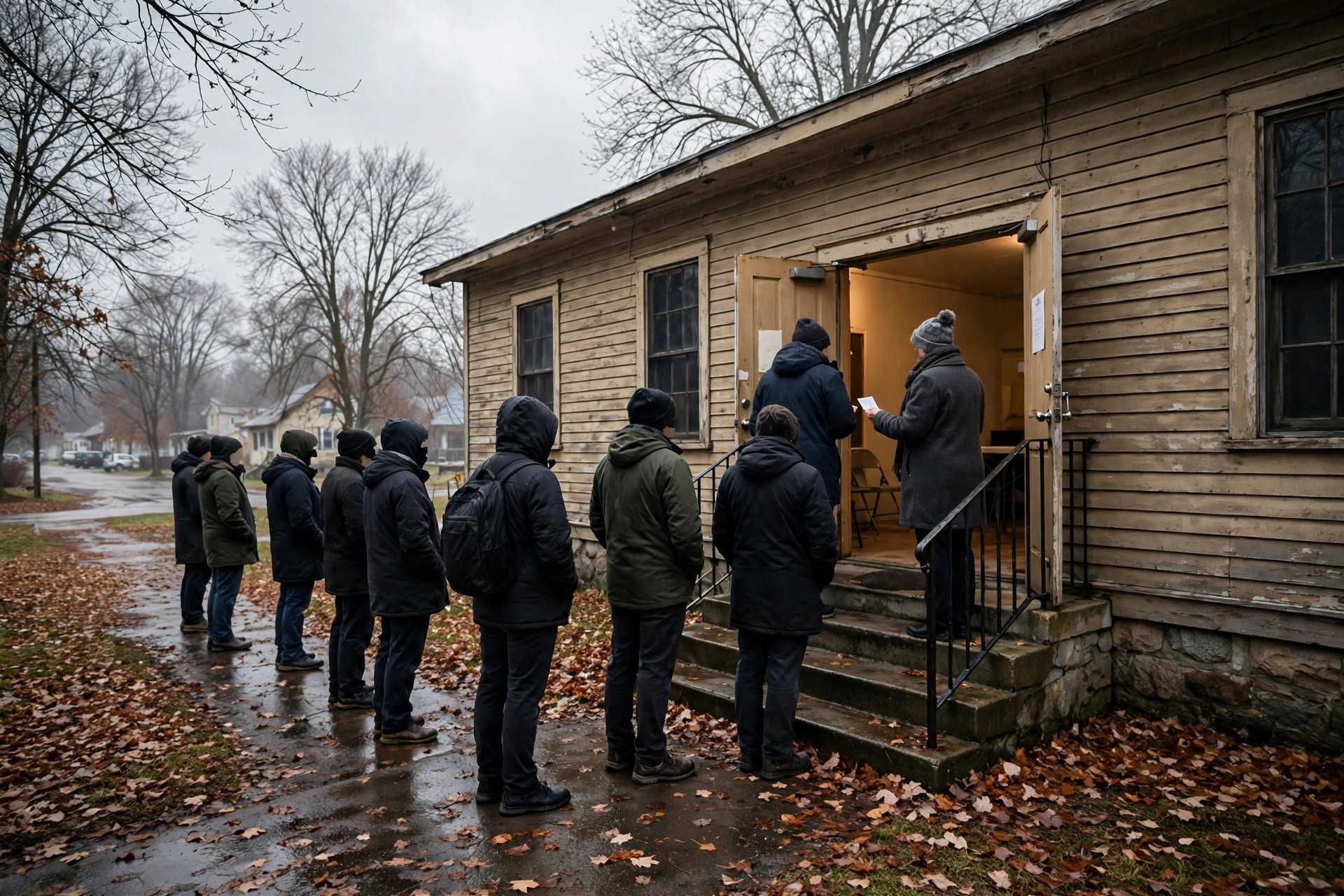
WILLOWMERE, Ont. — November 17, 2026 — “I have voted in every election in this town since 1978,” said Margaret Ellison, 74, standing outside the Willowmere community hall on Monday morning with her voter card in her hand. “They told me I was not on the list. I have lived on the same street for forty-one years.”
Ellison was not the only one. By noon on election day, 912 voters across Willowmere’s 14 polling stations had been told the same thing: their names were not on the voter list, and they could not be given a regular ballot. Some had registered to vote years ago. Some had updated their address online only weeks earlier. All of them were gone from the list all the same.
Willowmere is a fictional Ontario town of about 24,000 people, and Monday was its municipal election — mayor, council, and school board. The voter list is kept in an online system run by a fictional company, CivicRoll, which the town hired three years ago to replace its paper records. Voters register, check their polling station, and update their address through CivicRoll’s portal, and on election day the polling stations pull the list from the same system. On Monday, the list that came back was missing 912 names.
The names did not fall off the list by accident. Someone took them off.
Town clerk Diane Calloway says the town’s own records were untouched. The paper applications, the registration forms, the files the town keeps in its own office — all of them were still there, with all 912 names in them. The deletions happened inside CivicRoll’s system, sometime over the weekend, in the records of voters who had used the online portal in the last three weeks.
“We checked the paper first, because the paper does not lie to you,” Calloway said. “Every one of those 912 people is a real voter, in a real house, on a real street in this town. Their names were in our files on Friday. By Monday morning, they were not in the system. The only place they were missing was the list the polling stations were using.”
CivicRoll says an intruder got into the portal using a town employee’s login, and that the login had no second check — no code sent to a phone, no approval step, nothing beyond a password. The company says the password had been shared among several staff members and had not been changed in more than a year. Once inside, the intruder ran a routine-looking cleanup that marked hundreds of recent registrations as duplicates and deleted them. The company says it has closed the account, restored the list from its own backup, and is reviewing how its staff accounts are protected.
For the voters who were turned away, the fix came too late to be simple. The town allowed them to cast affidavit ballots — signed statements, sealed in envelopes, counted only after their registration is verified against the paper files. Calloway says every affidavit ballot will be counted, but the count will take days, and two council races are close enough that 912 ballots could change the result. The town will not declare a winner in those races until the verification is finished.
“I stood in line for forty minutes, and then they handed me an envelope and told me to sign it and hope,” said Harpreet Gill, 52, who registered online in October after moving to Willowmere from another town. “I did everything right. I registered, I got my card, I showed up. And on the day that matters, my name was just not there. An envelope is not a ballot. It is a promise that someone will sort it out later.”
A voter list that lives on one company’s server is only as safe as that company’s weakest password.
“People think of a voter list as a book in a town hall,” said Dr. Elena Vasquez, a fictional researcher who studies election systems. “But in Willowmere, the list is not a book. It is a database on a vendor’s server, changed through a web portal, by anyone with the right password. If that password is shared, never changed, and protected by nothing else, then the list is not guarded at all — it is just sitting there, waiting for someone to walk in and edit it. And the people who pay for that are not the vendor. They are the voters standing outside the hall with a card that says they belong.”
CivicRoll says no other town’s records were affected, and that the deleted names have been restored from backup. The company says it is adding a second login check to every staff account and will require passwords to be changed every 90 days. The town says it will keep a printed copy of the full voter list at every polling station from now on, and that no future election will depend on a single digital list with no paper behind it.
The affidavit ballots are being verified against the town’s paper files this week. Calloway says the two undecided council races will be called once the count is complete. Ellison says she will be back at the community hall for the next election — and she will bring her paper voter card, her driver’s licence, and a copy of her property tax bill, just in case.
Nine hundred and twelve people did everything they were asked to do, and on election day the system told them they did not exist.
Across Canada, towns and cities are moving voter lists, registration, and election records onto vendor systems, because a portal is easier to run than a filing cabinet. The convenience is real. So is the trade: the list that decides who can vote now lives on a server the town does not control, behind a password the town does not own, and when that password fails, the voters find out at the door of the polling station — on the one day of the year when it matters most.
Lessons Learnt
- Keep a paper copy of the list that decides who votes. Print the full voter list before election day and keep a copy at every polling station. When the digital list goes wrong, paper is what lets a voter cast a ballot instead of going home.
- Never let one shared password guard a public record. Every staff account on an election system should belong to one person, need a second check to log in, and be changed on a schedule. A password shared by a whole office and unchanged for a year is not a lock — it is an open door.
- Test the list before the day it matters. Check a sample of recent registrations against the live system the week before the election, and again the morning of. A problem found on Friday is a fix. A problem found on Monday is 912 voters in an envelope.
- Tell voters plainly and fast when something goes wrong. Say what happened, where to go, what to bring, and what happens to their ballot. People will accept a delay if they understand it — they will not accept being told they do not exist.
The affidavit ballots in Willowmere are being counted this week, and the two undecided council races will be called when the verification is done. Ellison says she has already put her voter card in her coat pocket for next time — along with her driver’s licence and her tax bill.
Watching the perimeter — and what slips past it.
ODTN News note: ODTN.News is a fictional news platform set within the Operation: Defend the North universe. All names, organizations, quotes, and events in this article are entirely fictitious. Any resemblance to real people, companies, or incidents is purely coincidental. The cybersecurity challenges it represents are very real.


Thousands of Bot Comments Buried a Town’s Budget Vote

Internet Vanished for Northern Towns Overnight

Ontario Factory Lost $86,000 Deposit to a Spoofed Supplier

Reddit Thread Over ‘Inventory Drift’ Surges as Canadians Vent Over Retail Glitches

Are Canadian Companies Learning from Global Cyber Attacks? Insider Insights into the Secret Downfall of Canadian Businesses

Canadian Airline NorthSky Faces Cyberattack, Disrupting Online Services


-
 Cybersecurity4 weeks ago
Tourists Scanned. Strangers Collected.
-

 Tech3 weeks ago
Smart Doorbells Streamed Porches to Strangers
-

 Tech3 weeks ago
Kingston Drivers Charge Cars, Drain Accounts
-

 Cybersecurity4 weeks ago
Sudbury Boss’s Voice Calls From Another Phone
-

 Cybersecurity4 weeks ago
Regina Pharmacy Shut Out of Its Own Prescriptions
-

 Cybersecurity4 weeks ago
Winnipeg Distributor Loses Payment to Impostor Email
-

 Politics3 weeks ago
Fredericton Council Meeting Streams From a Stranger’s Server
-

 Business3 weeks ago
Canmore Travellers Book a Room That Isn’t There