

Business
Customers Called the Shop. Strangers Answered.


ALDERBROOK, Ont. — November 19, 2026 — Between Friday evening and Monday morning, 214 people called Mendez Family Bakery in Alderbrook. Not one of them spoke to anyone at the bakery.
Carla Mendez, 48, owns the bakery, and she found out the way most of her neighbours did — from a customer standing at her counter on Monday morning, asking where the wedding cake was.
“I called three times on Saturday to order a cake for my daughter’s wedding,” the customer told her. “A man answered, he was very polite, he took the order, and he asked me to send a $200 deposit by e-transfer. I sent it. He even gave me a pickup time.”
Mendez had never spoken to the man. She had never taken the order. The $200 went to an account she has never seen, and the cake was never baked.
Alderbrook is a fictional Ontario town of about 14,000 people, and twelve of its small businesses — the bakery, a garage, a pharmacy, a florist, a dental clinic, and seven others — all get their phone service from the same fictional company, NorthCall. Instead of a phone line into each shop, NorthCall runs the numbers through its own system online, and the calls travel over the internet to the phone on the counter. Sometime on Friday evening, the calls stopped arriving at the shops. They went somewhere else instead.
The phones were not broken. They were still answering — just not to the people who owned them.
Gordon Hale, 61, runs Hale’s Auto Repair on the edge of town. His customers spent the weekend calling to book winter tire changes, the busiest job of the year. The person who answered told them the garage was booked solid until December, and that they could hold a spot with a $150 deposit, paid by card over the phone.
“The first I heard of it was Monday, when a man came in with his car and asked why I had charged him $150 for a booking I had never made,” Hale said. “I told him I had not charged him anything. He showed me the charge on his phone. It was my garage’s name on the call, my number, and a stranger’s voice taking his money. I have been in this town thirty years. People trust my number. That is the whole business, right there — they call, I answer. This weekend, somebody else answered.”
NorthCall says the calls were rerouted by changing the forwarding rules on its customer portal — the same screen a business owner uses to send calls to a mobile after hours. The change was made with the login of a phone installer who had set up NorthCall systems in Alderbrook two years ago. The installer’s account could change the forwarding on every number he had ever installed, and it was never closed when his work in the town ended. It was protected by a password alone — no second check, no approval step, nothing beyond the login.
“We trusted that account because it belonged to someone who had done good work for us,” said Peter Novak, NorthCall’s operations manager. “We never asked what it could still reach after he stopped working for us. Somebody else asked, and they found out. We have closed the account, restored every number, and we are reviewing every login that can change a customer’s call routing.”
A phone number used to be a wire into a shop. Now it is a setting on somebody else’s website — and whoever can change the setting can answer the phone.
For the twelve businesses, the weekend was the busiest of the month, and it is gone. The bakery lost a weekend of cake and catering orders it will never get back. The garage lost bookings it cannot reschedule before the snow. The pharmacy spent Monday calling patients to explain that the person who took their prescription refill over the phone was not the pharmacy. NorthCall says it does not yet know how many callers paid deposits to the strangers who answered, or how much money was taken in total. The police are involved.
“It was not a break-in. Nobody smashed a window, nobody took a till,” said Anne Kowalski, chair of the Alderbrook Business Association. “They just answered our phones for us, for three days, and took the money our customers were trying to give to us. A shop’s phone number is the front door. If someone else is standing in it, you are closed — and you do not even know it.”
“People think of a phone call as a direct line to the shop they dialled,” said Dr. Rachel Kim, a fictional researcher who studies how small businesses rely on cloud services. “But a cloud phone number is not a wire. It is a rule in a company’s system, and the rule says where the call goes. If that rule can be changed from anywhere, by anyone with the right login, then the number on your shop window belongs to whoever changed the rule last. Your customers will never know the difference. The voice sounds polite. The order sounds normal. The only thing that has changed is where the money goes.”
In this fictional case, NorthCall says every number is back with its owner, and that no forwarding rule can now be changed without a second approval from the business itself. The twelve businesses say they will keep taking orders by phone — but Mendez says she will call her own number from her mobile every morning before she opens, just to hear who answers.
The shops were open all weekend. Their phones were answered all weekend. The only thing missing was the shops themselves.
Across Canada, small businesses have moved their phones, their bookings, and their payments onto systems run by other companies, because a cloud phone is cheaper than a phone line and easier than a switchboard. The convenience is real. So is the trade: the number on the window now lives in a portal the shop does not run, and the person who answers it is whoever the portal says should answer. When that changes without the shop knowing, the customers keep calling — and the shop never hears a thing.
Lessons Learnt
- Know who can change where your calls go — and ask for a list. Call your phone provider and ask which accounts can change your number’s routing. If a former installer, a reseller, or an old employee can still reach it, have that access closed. A number you cannot control is not your number.
- Call your own business number from your mobile once a month. It takes a minute. If a stranger answers, or the greeting sounds wrong, you find out the same day — not on Monday, after a weekend of lost orders.
- Put your payment instructions in writing, where customers can check them. List on your website, your receipts, and your door how you do — and do not — take deposits. When a caller asks for money in a way that contradicts what is written down, your customers have a reason to stop and call back.
- Keep a second way for customers to reach you. Put a mobile number or an email address on your door and your website, separate from your main line. If your main number is ever rerouted or goes dead, your customers still have a door that opens.
Watching the perimeter — and what slips past it.
ODTN News note: ODTN.News is a fictional news platform set within the Operation: Defend the North universe. All names, organizations, quotes, and events in this article are entirely fictitious. Any resemblance to real people, companies, or incidents is purely coincidental. The cybersecurity challenges it represents are very real.











TARNWICK, Ont. — November 16, 2026 — The first loan was for $18,000, approved in nine minutes, for a bakery that has never baked a loaf. The forty-seventh was for $96,000, for a machine shop with no machines, no staff, and an address that turns out to be an empty lot behind the bus depot.
Tarnwick is a fictional Ontario town of about 21,000 people, and its Small Business Fund was supposed to be the town’s proudest idea: low-interest loans to help real shops, garages, and cafés survive a hard year. Between July and October, the fund approved 47 loans worth $2.3 million. This week, the town discovered that not one of those 47 businesses exists.
The money did not go to struggling shopkeepers. It went to storefronts that were never there, and the fund’s own paperwork said every one of them was real.
The fund’s checks looked solid on paper. Each application carried a business registration number, a phone number, a website, and two references. The fund’s staff verified the numbers against a registry, called the phones, and visited the websites. Every check came back clean — because the registry entries, the phones, the websites, and the references had all been set up by the same people applying for the money.
The one check that would have caught it was a visit to the address. The fund used to send someone to every applicant’s door before approving a loan. That practice was paused in the spring, when two staff members left and were never replaced, and the fund decided the paperwork checks were enough. Nobody told the town council the visits had stopped.
“We were approving loans faster than ever, and we took that as a sign the program was working,” said Elaine Marsh, the fictional fund’s director. “Forty-seven approvals in four months felt like forty-seven small businesses getting a chance. It was forty-seven empty rooms. The paperwork was perfect because the paperwork was the product. There was never a business behind it.”
The fund trusted documents that anyone could print. The documents trusted the fund right back.
Meanwhile, real businesses in Tarnwick were being turned away. Tom Beckett, who runs a fictional hardware store on Main Street, applied for $25,000 in August to replace a roof that leaks every time it rains. He was refused — the fund said his revenue history was too thin. “I have been open eleven years. I pay my taxes in this town, I hire kids from this town, and I got a no in three weeks,” Beckett said. “Somebody with a website and a phone number got a yes in nine minutes. I would like to know what my eleven years were worth.”
The town says the money was wired to accounts that were emptied within days, and it does not expect to recover most of it. The fund has frozen all new lending, and the town says it will not restart the program until every application is checked in person, every registration number is confirmed with the province directly, and no loan is approved on paperwork alone.
“These funds exist because a loan from a bank is too slow or too hard for a small shop,” said Dr. Helen Okafor, a fictional researcher who studies how small-business lending is abused. “So towns build a faster, friendlier process — and then they forget that the slow parts were the parts doing the checking. Speed is not a service if the money leaves town and never comes back.”
Tarnwick’s fund was built to move fast for real businesses. It moved fastest for the ones that were never there.
Across Canada, towns run loan funds, grant programs, and relief schemes on the same kind of trust: a form, a phone call, a website, and the belief that nobody would bother faking a small business for $18,000. In Tarnwick, somebody bothered 47 times — and the town’s real shopkeepers are the ones still waiting for help.
Lessons Learnt
- Never approve money on paperwork alone. Before any loan or grant is paid, someone from your organization should visit the address, meet the owner, and see the business operating. A visit is not bureaucracy — it is the one check that cannot be faked from a laptop.
- Ask your team what checks were quietly dropped. When staff leave or budgets tighten, verification steps get paused and nobody announces it. Leaders should ask, in plain terms: what did we stop checking, and when did we stop?
- Verify registrations with the source, not the applicant. A registration number on a form is a claim, not proof. Confirm it directly with the issuing authority, and treat a phone number or website supplied by the applicant as their own marketing, not evidence.
- Protect the real applicants first. Every dollar paid to a business that does not exist is a dollar a real shopkeeper cannot borrow. When a program moves fast, ask who is being left behind by that speed — and slow down for them.
Tarnwick’s town council meets Thursday to decide whether the fund continues at all. Beckett says he will be there, roof still leaking, application still open.
Watching the perimeter — and what slips past it.
ODTN News note: ODTN.News is a fictional news platform set within the Operation: Defend the North universe. All names, organizations, quotes, and events in this article are entirely fictitious. Any resemblance to real people, companies, or incidents is purely coincidental. The cybersecurity challenges it represents are very real.

WRENFIELD, Ont. — November 13, 2026 — Four hundred and twelve people woke up on Friday expecting to be paid. None of them were. The money was in their employers’ accounts. The hours had been logged, the deductions calculated, the deposits scheduled. But the company that moves the money from one account to the other had gone dark overnight, and by the time anyone understood why, payday was already over.
Lakeshore Payroll Services is a fictional payroll firm in Wrenfield, a fictional Ontario town of about 14,000 people, that handles pay for roughly forty small businesses across the region — bakeries, diners, a hardware store, a landscaping crew, a daycare, and a dozen more. On Thursday evening, the firm’s computers locked up. The files that hold every client’s pay runs, tax deductions, and bank details were encrypted behind a ransom demand, and the staff could not open a single one.
More than four hundred workers went unpaid on a Friday — because the company that runs their payroll was locked out of its own files.
The firm says the trouble started with an email to its bookkeeping desk on Wednesday afternoon. It looked like a routine message from a fictional benefits provider, asking a bookkeeper to open an attached form. She did. The ransomware inside it spread through the office network in under an hour, and by Thursday morning the payroll system itself was locked. The firm says it did not pay the ransom, and no client data has been published. But the pay runs for Friday were inside the locked files, and there was no way to get them out in time.
“We had the money. We had the hours. We had everything except the file that puts the two together,” said Colin Barrett, the fictional firm’s owner. “I spent Friday morning on the phone with forty business owners, telling them their people would not be paid today, and I had no date I could give them. These are not big companies. Their staff live paycheque to paycheque. A missed Friday is a missed rent payment, a missed grocery run, a missed car payment — and it happened to all of them at once.”
Marta Kowalski, who runs a fictional bakery in Wrenfield, was one of the forty. She says she spent Friday afternoon writing paper cheques by hand for her nine staff, working from the hours she keeps in a notebook, while her own rent came due the same day. “I have run this bakery for eleven years and I have never missed a payday,” she said. “On Friday I was standing at my own counter, adding up hours on a calculator, because the company I pay to do this for me could not open its own computer. My staff were kind about it. They should not have had to be.”
The firm did not lose the money. It lost the list of who gets paid, and how much — and without that list, payday did not happen.
Payroll is the kind of service small businesses never think about until it stops. A bakery, a diner, or a daycare does not keep a payroll department; it pays a firm to handle the arithmetic, the deductions, and the deposits, and it trusts that the firm has its own backups and protections. When that firm goes down, the failure lands on forty employers at once — and on every one of their workers, at the same hour, on the same day.
“People picture a cyberattack on a business as a stolen credit card or a hacked website,” said Dr. Alan Reyes, a fictional small-business finance researcher who studies how small firms recover from attacks on their suppliers. “But the attacks that hurt ordinary people most are the ones that stop a service they never see. A payroll firm is a single point of failure for dozens of small employers. Lock its files on a Thursday night and four hundred people wake up unpaid on Friday — and none of them did anything wrong.”
In this fictional case, the firm says it rebuilt its payroll system from backups over the weekend and the missed pay runs went out on Monday, three days late. It says the bookkeeper’s email account has been rebuilt with a second login check, and the payroll files are now kept on a separate system from office email. It has not said how many workers were still waiting for their money by Monday, or whether any of the forty businesses have moved their payroll elsewhere.
The fictional businesses say they have since changed how they treat payday. Each one now keeps its own copy of staff hours and pay rates, updated every week, so a payroll failure does not leave them guessing. Several have agreed on a shared emergency plan: if the deposits do not land by Friday morning, the owners write paper cheques the same day, from their own records, instead of waiting for the firm to recover.
The defence is not a sharper eye for suspicious emails. It is never letting one locked file decide whether four hundred people get paid.
That advice applies well beyond one payroll firm. Across Canada, small businesses hand their most time-critical work — payroll, invoicing, scheduling — to a single outside provider, and rarely ask what happens if that provider goes down on the wrong day. A missed payday is not a data breach. It is a week of rent, groceries, and bills arriving on time while the money does not.
Lessons Learnt
- Ask your payroll provider how they would pay your people if their system went down. A good provider has a tested backup and a plain answer. If they cannot explain it, that is your answer.
- Keep your own copy of hours and pay rates, updated weekly. If the payroll firm cannot open its files, your own records let you pay people by cheque the same day instead of waiting.
- Hold a cash buffer for one payroll cycle. A missed payday becomes a crisis when there is nothing to bridge it. One cycle’s worth of payroll in reserve buys your staff time.
- Put payday in your incident plan. Decide now who writes the cheques, who tells the staff, and what you say to them. The first time you make that decision should not be on a Friday morning.
The fictional firm says the missed pay runs have now gone out, and the workers from Wrenfield’s small businesses have been paid. The money arrived three days late. The Friday it was supposed to arrive on is the part nobody gets back.
Watching the perimeter — and what slips past it.
ODTN News note: ODTN.News is a fictional news platform set within the Operation: Defend the North universe. All names, organizations, quotes, and events in this article are entirely fictitious. Any resemblance to real people, companies, or incidents is purely coincidental. The cybersecurity challenges it represents are very real.

COPPERTON, Ont. — November 10, 2026 — The wire transfer was for $214,000, and it took eleven seconds to send. Elena Marsh, who owns a mid-sized food export business in Copperton, had paid the same supplier the same way for four years. The invoice looked right. The email address looked right. The only thing that had changed was the bank account number at the bottom — and by the time anyone noticed, the money was gone.
Marsh is one of at least a dozen Ontario exporters who wired payments to bank accounts controlled by criminals this autumn, after attackers posed as a long-time supplier and sent out new payment instructions. The supplier was real. The invoices were real. The bank accounts were not.
A dozen Ontario exporters paid real invoices into accounts that did not belong to their supplier — and the money is gone.
The scheme was patient. For weeks, the attackers watched the email traffic between the exporters and Prairie Malt & Grain Co., a fictional Manitoba supplier that ships grain and milling products across the country. They learned the order cycle, the invoice format, and the names of the people who approve payments. Then, just as the autumn shipping season peaked, they sent a short message from an address one letter off the supplier’s real one: new banking details, effective immediately, please update your records.
“There was no urgency in it, no threat, nothing that would make you stop and think,” Marsh said. “It read like the kind of administrative note you get three times a year. I forwarded it to our bookkeeper the same afternoon, and the next invoice went to the new account. It felt like routine.”
The real supplier only discovered the switch when it called about an overdue balance. By then, the exporters had wired nearly $900,000 to accounts the criminals controlled, and the money had already been moved on. The fictional exporters say their banks were able to freeze a small portion of the transfers. The rest is gone.
The invoice was genuine. The supplier was genuine. Only the destination had changed.
Business email compromise works because it asks for nothing unusual. No malware, no ransom note, no locked system — just a familiar invoice, a familiar sender, and one changed detail at the bottom of the page. Finance teams process hundreds of supplier payments a month, and a new bank account notice arrives looking like the most boring email of the day. That is exactly why it works.
“Attackers don’t break into the payment system. They break into the conversation around it,” said Marcus Hale, a fictional payments-fraud consultant who advises mid-sized Canadian exporters. “They wait until the relationship is routine, then they change one thing. A company that would question a strange invoice will pay a familiar one without a second look — and by the time the real supplier calls, the money has crossed three borders.”
In this fictional case, the attackers had been inside the email chain for more than a month before sending the new banking details, according to investigators. They timed the switch for the busiest weeks of the shipping season, when finance staff were processing invoices at volume and had the least time to check. None of the exporters had a rule requiring a phone call to confirm a change of bank details.
The fictional exporters say they have since changed how supplier payments work. No bank account change is accepted by email alone — it must be confirmed by a phone call to a number the company already has on file. Payment approvals above a set amount now need a second person to sign off. And any message about new banking details is treated as suspicious until proven otherwise.
The defence is not a sharper eye for fake invoices. It is never changing where money goes on the strength of an email alone.
That advice applies well beyond one shipping season. Across Canada, small and mid-sized businesses pay suppliers the same way every month — same invoices, same senders, same routine — and a single changed account number is all it takes to redirect a payment. The defence is not a cleverer spam filter. It is a habit of verifying every change of payment details out of band, by phone, before a single dollar moves.
For businesses, the checklist is short: never update a supplier’s bank details from an email alone — confirm it by calling a number you already have; require two people to approve any payment above a set threshold; and treat any message about new banking details as a fraud attempt until proven otherwise. For suppliers, it is equally simple: never send new bank details by email, publish a standing warning that payment details only change by phone, and call your customers the moment an invoice goes unpaid.
The fictional exporters say the fraudulent accounts have been reported, and the real Prairie Malt & Grain Co. continues to ship to its Ontario customers.
The invoices were never fake. The supplier was never fake. And the difference — one phone call, made before the money moved instead of after — was all it took.
Watching the perimeter — and what slips past it.
ODTN News note: ODTN.News is a fictional news platform set within the Operation: Defend the North universe. All names, organizations, quotes, and events in this article are entirely fictitious. Any resemblance to real people, companies, or incidents is purely coincidental. The cybersecurity challenges it represents are very real.


Customers Called the Shop. Strangers Answered.

Residents Paid Their Taxes. The Town Never Got Them.

The Shelf Said One Price, the Till Another

Reddit Thread Over ‘Inventory Drift’ Surges as Canadians Vent Over Retail Glitches

Are Canadian Companies Learning from Global Cyber Attacks? Insider Insights into the Secret Downfall of Canadian Businesses

Canadian Airline NorthSky Faces Cyberattack, Disrupting Online Services


-
 Cybersecurity3 weeks ago
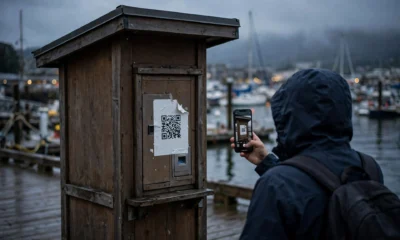
Tourists Scanned. Strangers Collected.
-

 Tech2 weeks ago
Smart Doorbells Streamed Porches to Strangers
-

 Cybersecurity3 weeks ago
Sudbury Boss’s Voice Calls From Another Phone
-

 Cybersecurity3 weeks ago
Winnipeg Distributor Loses Payment to Impostor Email
-

 Cybersecurity3 weeks ago
Regina Pharmacy Shut Out of Its Own Prescriptions
-

 Tech2 weeks ago
Kingston Drivers Charge Cars, Drain Accounts
-

 Business3 weeks ago
Winter Cargo Vanishes on Paper Trail
-

 Politics2 weeks ago
Fredericton Council Meeting Streams From a Stranger’s Server